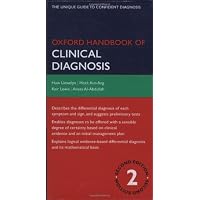
Average Reviews:

(More customer reviews)Are you looking to buy Oxford Handbook of Clinical Diagnosis (Oxford Handbooks)? Here is the right place to find the great deals. we can offer discounts of up to 90% on Oxford Handbook of Clinical Diagnosis (Oxford Handbooks). Check out the link below:
>> Click Here to See Compare Prices and Get the Best Offers
Oxford Handbook of Clinical Diagnosis (Oxford Handbooks) Review
As you can see from the preview section, the information is divided up into 10 topics. One topic is "Psychiatric and Neurological Symptoms and Signs". This chapter is about 80 pages long. There were alomost 70 topics covered in the section. As a psychiatrist, I felt competent to reflect on the quality of 16 of the differentials. The most note-worthy were as follows.General Anxiety
===============
Page 570,1. The listed "Main differential diagnoses" were as follows: GAD, Panic disorder, alcohol withdrawal, thyrotoxicosis, hypoglycaemia, phaeochromocytoma. This is a DDx list of 6, of which the sixth is phaeochromocytoma! Have you ever seen a phaeochromocytoma? Me, either. That's a dumb differential for a beginner's book. Panic disorder is "confirmed" by the basic DSM IV criteria for panic disorder (as if, if someoene had only had 3 (and not 4) episodes of panic in the last month they wouldn't have the disorder) and the following organic exclusions: thyrotoxicosis, hypoglycaemia, Cushing's disease, phaeo', and no other physical cause of symptoms. Well: the "no other" is the bit of this book that I wanted to know about. And it was dumb to put phaeo' ahead of cardiac ischaemia, cardiac arrhythmia, hypoxia, cardiac ischaemia, major depressive disorder, agitated depression, psychosis and etc.
The section on alcohol withdrawal says that there is decrease in MCV, which is wrong. It also says that the initial management is "sedation and alcohol detoxification (e.g. chlordiazepoxide) with tailing off over days." May I suggest, 20 mg oral diazepam, IV thiamin and call the registrar as a better plan?
The section on thyrotoxicosis gives the basic management of thyrotoxicosis. Would anyone striking this rare diagnosis not have time to look up Oxford Clinical Medicine?
Anxiety Response to Specific Issues
===================================
This section has numerous problems. For example, one of the DDx's is somatization disorder. The Initial Management includes: "explanation of mechanisms of symptoms. May I suggest that what no body needs is the resident taking it upon themselves to explain to the patient that their symptoms are all in their head.
Simple phobia. They recommend "flooding, implosion therapy, and benzos", amongst a few other things. If someone routinely treated simple phobia with benzos, I would recommend reviw by the medical board. As for flooding, are there many fully qualified psychiatrist/psychologist who would not confer with other seniours before they did this? Remember, this is a book for juniours.
In the PTSD section, they give some manaement ideas, but do not mention the all-important first aid following traumatic events.
Depression
==========
Major depression has "Antidepressant, especially if somatic syptoms" as the initial management. I suggest that decisions about what therapy to use should be made according to severity (and patient preference) rather than the presence of somatic spymtoms). The differential "Depression Secondary or Partly Due to Other Conditions" suggests that this diagnosis is "Suggested by any other illness that undermines self-confidence , e.g. physical illness but especially anxiety disorders, alcohol abuse, substance abuse." This suggests that the mechanism of alcohol induced depression is the undermining of one's self-confidence! Unbelieveably dumb.
The section "Depression Secondary or Partly Due to Medication" mentions beta blockers first. It is possible that they cause depression. But they do not mention medications for dyslipidaemias!
Delusions
=========
The physical differentials listed are only: infection, hypothyroidism, etc. This is dumb. They also say that schizophrenia is "confirmed" if you have two schniederian first rank symptoms for a month or more and clear sensorium (if you are not manic or depressed). This is so dumb.
Acute Confusion
===============
Reasonable DDx, I think. But I am not an expert in Dx-ing acute confusion.
Fatigued, "Tired all the time"
==============================
Diabetes is 7 out of a DDx of 10. I think is should have been listed ahead of Post-Viral Fatigue, don't you?
Disturbed Consciousness
=======================
Page 604. Recons "probably moderate brain injury" if CGS is 9-12. I'll keep it in mind next time someone overdoses. Details the scoring and categories, but does not tell you how to do the test - i.e. how hard to try and wake the person up.
Speech Disturbance
==================
Recons "Innatention dut to dementia, depression, etc" is "confirmend by low MMSE with or without CT/MRI showing cerebral atrophy". Way to ignore delerium and any number of psychiatric illnesses, Einsteins.
Course Tremor
=============
Lists hepatic failure (a flap is not a tremor, guys). Much worse: their entire DDx list for Parkinsonian tremor is: Park Dis, Lewy body Dem, drug-induced, post-encephalitis and morm press hydro. Dear Reader, please refer to page 499 of the OHoCM for a decent DDx.
Brisk Reflexes
==============
Three differentials: thyrotoxicosis, pyramidal tract x2. Well: brisk reflexes is probably the first sign of serotonin syndrome that is not caused by anxiety, so, how bouts mentioning it?
Diminished Reflexes
===================
The DDx does not include "normal for them" which I recon is the most important cause.
---------
After all that, the authors have the cheek to have a complicated, mathematical chapter at the back of the book about pre and post test probability and what not. I suggest that the authors concentrate on getting the basic differentials right, not being so reckless about saying when a diagnosis is confirmed, forget about listing rare treatment (e.g. flooding) and list urgent management (e.g. IV thiamine).
Also, I understand English is commonly spoken and written in England, so, can some joker stop these bozos using 'danger quotes' wrongly. Which gets me started on their excuse of a MSE. The say " 'affect' " and don't bother defining or using the word. (It means "facial expression" at your level).
The bits of this book that I have read are no good for students, residents, registrars or consultants of any speciality. If you want a book about DDx, start with Differential Diagnosis Pocket (Pocket (Borm Bruckmeier Publishing)).
P.S. For dementia, there are only 5 differentials. The 5th is CJD. I can see it now, consultants sitting around the tea room, laughing at how the resident missed a case of CJD, all because the resident didn't read this book... not. Here's hint from me, next time you wonder if someone has dementia, don't bother ruling out CJD, ok?
P.P.S. For Abnormal tongue movement, they have four DDx's all and the way to tell the difference is with MRI for each of the four. Way to waste a page! Except that they forgot to list tardive dyskinesia, which can not to be Dxed by MRI. Way to waste my money, Huw.
Oxford Handbook of Clinical Diagnosis (Oxford Handbooks) Overview
The Oxford Handbook of Clinical Diagnosis is the first and only book that describes the diagnostic process clearly and logically so that it can be effectively learnt.It showshow to justify intuitive diagnoses clearly and logically in an evidence-based way.It provides the differential diagnosis of every symptom, physical sign and initial test result.This handbook uses 'pattern recognition tables' which enable the reader to scan the page to see which diagnostic explanation would apply best to a patient or case history. The book is aimed at medical students and others who wish to improve their diagnostic skills and interactions with patients.It describes how to justify diagnoses and management decisions verbally or in writing and clarifieswhat evidence is needed from research, and its statisticalfeatures.It provides senior doctors with a clear framework and examples help to teach trainees and students to approach diagnostic problems in a logical way and to effectively justify their opinions.It provides all doctors with practical help when dealing with problems outside their immediate field of expertise, especially general practitioners and those who are faced with unforeseen situations and emergencies.Want to learn more information about Oxford Handbook of Clinical Diagnosis (Oxford Handbooks)?
>> Click Here to See All Customer Reviews & Ratings Now

0 comments:
Post a Comment