Average Reviews:

(More customer reviews)Are you looking to buy Data Monitoring in Clinical Trials: A Case Studies Approach? Here is the right place to find the great deals. we can offer discounts of up to 90% on Data Monitoring in Clinical Trials: A Case Studies Approach. Check out the link below:
>> Click Here to See Compare Prices and Get the Best Offers
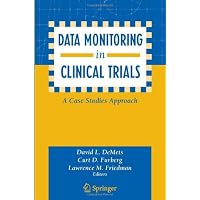
Data Monitoring in Clinical Trials: A Case Studies Approach Review
DATA MONITORING IN CLINICAL TRIALS, by DeMets, Furberg, and Friedman, is 374 pages long. There are three chapters totaling 49 pages, followed by 29 case histories, each about ten pages in length. The first three chapters provide narratives to the case histories. Thus, the reader knows when to jump ahead in the book to one or more of the case histories, depending on his or her interest. Although the book is "about" Data Monitoring Committees (DMCs), the book provides guidance to most aspects of managing a clinical trial. This book discloses many subtle facts on the logistics of clinical trials, including how various groups (DMC, Institutional Review Board, study subjects, sponsor) are supposed to communicate with each other. In view of the excellent guidance provided by this book, I would recommend DATA MONITORING IN CLINICAL TRIALS to all managers and medical writers involved in clinical trials. The book walks the reader through many interesting decision-making trees.My criticisms are that the book fails to provide any examples of a DMC Charter or a DSMB Charter, fails to provide an example of a DMC's recommendation or report, and that chapter 3 is on the sketchy side.
In chapter 1, we learn that the main purposes of a DMC is to ensure that subjects are not being harmed by the study drug or by the standard of care, and to ensure that the Clinical Study Protocol (CSP) is being followed (page 3). We learn that, for small single-center studies, an Institutional Review Board (IRB) is sufficient to do this job, but that for multi-center studies, both an IRB and DMC are needed. We learn that DMC had its origin in the "Greenberg Report" from 1967. The Greenberg Report was innovative in that it provided for an independent board (independent of investigators) that received study data, and where this data was kept secret from the investigators.
MEMBERSHIP OF DMC. Regarding members of the DMC, we learn that "the more distant and independent the better, but complete independence from the sponsor should not come at the expense of needed expertise" (page 6). We learn that DMC members must disclose conflicts of interest, on an ongoing basis during the clinical trial. We learn that DMC meetings have an open session component, dealing with administrative issues, baseline data, and adherence to the CSP, and a closed session, where unblended data is discussed. Administrative aspects include, e.g., are the subjects completing their forms; are subjects being enrolled on a timely basis; are the subjects adhering to the drug regimen?
We learn the definition of clinical equipoise: The state of not knowing which of the study arms is preferred, and gives the best results, as far as efficacy and safety are concerned.
We learn these things. The DMC needs to be alert of other trials using the same drug (pages 10 & 32, Cases 2, 8,15, 24, 27). Regarding other trials, the authors caution that study design may differ, for example, the relative time between the myocardial infarction and time of first administering the drug (the 2 studies were judged not likely relevant to each other) (page 32). The DMC may, if needed, recommend modification or termination of the present clinical study depending efficacy and safety results from the other trial (page 10, case 24).
RECOMMENDATIONS FROM A DMC. We learn that the DMC can recommend extending a trial, where the rate of outcome (primary variables) is too low, and that this strategy can be built into the CSP (page 11, Cases 8 & 27). We learn that the DMC can recommend stopping for (1) Overwhelming evidence for efficacy, (2) Serious harm, (3) Hopelessness that the study drug will work (Case 3), and (4) Extremely poor compliance by subjects with the CSP, and (5) Evidence from another trial that the drug works (or fails to work) (page 10). We that if changes are to be made to the CSP, they should be made sooner, not later (page 16, Case 27). We learn that where changes are made in the CSP, the FDA can become suspicious that the sponsor had a knowledge of the results (efficacy data and safety data) (page 43). In other words, the problem is that the sponsor can change the nature of the primary endpoint so that it is consonant with actual data that is coming out of the study population (pages 42-43). We learn of examples where the DMC was unable to provide a recommendation, and where an ad hoc committee or policy board was formed (pages 17, 29, 32 & Cases 12, 15, 18). We learn of the fact-pattern where the DMC recommended change in the CSP, where one change was a more stringent exclusion criterion, and the other related to drug administration (a slower drug infusion rate) (page 18 & Case 23). We learn this tidbit about scheduling DMC meetings--where materialization of certain adverse events (AEs) required the scheduling of an emergency teleconference by the DMC (page 19 & Case 16).
LAGGING DATA. We learn an interesting detail of the common problem of lagging reports from study subjects, where a "sweep" was implemented, where every subject was contacted at the same time (page 19 & Cases 9 & 22). We learn that under-reporting can result in an accumulation of data showing lack of efficacy (or poor safety) and that correcting the non-reported data can result in the disappearance of these disappointing trends (pages 20 & 24 & Case 22). We learn that the CSP should include a schedule for interim analyses (page 20 & Case 28). We learn of pre-determined stopping rules, where the rules were linked to the amount of data collected, and where stopping for benefit required data to be more convincing, than stopping for harm (page 21 & Case 19).
UNEXPECTED ADVERSE EVENTS. We learn that where an unexpected AE presents during a trial, e.g., cataracts or pulmonary embolism, this may require all study subjects to be informed of the risk, and to fill out a Re-Consent Form (pages 21 & 26 & Cases 7 & 17). We learn that a consent form is a contract between the investigator and subject (page 22). We learn of the hierarchy in obtaining data: data on mortality must be very current, data on serious adverse events (SAEs) must also be very current, data on primary outcome other than mortality can be a few months old, data on lab results and data on concurrent medications can also be old and not current (page 24). We learn that, at any given time, the DMC can choose to unblind the data or to maintain blinding (page 25 & Case 13). We learn that the sponsor can improve the efficiency of the DMC, by providing the DMC with a mock report at the DMC's first meeting (page 25).
EARLY DATA MISLEADING. We learn that early data from study subjects can be misleading, and that early trends can disappear later on (pages 25 & 31 & Cases 5, 11, 12, 17). Where the DMC can't decide whether to recommend stopping the trial or to recommend continuing, we learn that a third avenue is available--deciding to hold more frequent DMC meetings to evaluate incoming safety data (page 26). We learn the value of knowing the mechanism of a disease--where several symptoms are known to be part of the same disease, each of these symptoms can be listed as an outcome in the CSP, and a "composite outcome" can be set forth as an endpoint (page 26). A composite outcome is especially justified where each symptom responds in the same way to the study drug. For example, Case 10 discloses the composite outcome of death, infarction, and stroke (page 27 & Cases 7, 11, 27).
DEFINE SUBGROUPS. We learn of the advantages of defining subgroups (strata) in the CSP. For example, if an unacceptable AEs occur in the study, but where these are clustered in one of the subgroups, the DMC can recommend terminating this subgroup (rather than terminating the entire study (pages 28-29 & Case 12). We learn that the CSP must be written in a manner that adequately defines the subgroups. We also learn that what at first might be reasonable subgroups(ischemic and non-ischemic), turn out to be irrelevant to response of subjects to the drug (page 29). We learn that the group of subjects defined by a subgroup is not the same as a group of subjects presenting with a specific outcome for a surrogate marker, though these might seem to be the same, at first glance, to a layperson. We learn that it is preferable for a surrogate (or biomarker) to capture the full effect of the study drug (page 30). We learn of an example of surrogates (arrhythmia suppression; lipoprotein levels; cardiac function, microaneurisms) that were misleading, and that was not predictive of mortality or of coronary events (pages 30-31 & Cases 5, 13, 14, 17). We learn about follow-up procedures that occur long after the trial has ended or has been terminated early (pages 33-34, Cases 1, 12, 17). In Case 12, the trial itself showed no efficacy of the drug, while a follow-up after 9 years showed good effect. We also learn that studies can be terminated because the money ran out, or because the company changed hands (pages 34-36).
GOVERNMENT GUIDANCE ON ROLE OF DMC. Chapter 3 informs us on guidance on the nature of DMCs from the U.S.government ("Guidance for Clinical Trial Sponsors on the Establishment and Operation of Clinical Trial Data Monitoring Committees") and from International Conference on Harmonization.
INTERIM DATA. Chapter 3 provides interesting guidance on what to do with interim data. We learn about use of interim data (comprising data on surrogate endpoints such as viral load) and whether it should be used as a basis for stopping a trial for efficacy--we learn that it is more acceptable to stop a trial on the basis of interim data if the trial is nearly complete, and less acceptable to stop a trial still in its early stages (because that particular trial will not yet allow any valid conclusion) (page 42)...Read more›
Data Monitoring in Clinical Trials: A Case Studies Approach Overview
From the authors of "Fundamentals of Clinical Trials" which has sold over 15,000 copies world wide since its publication in 1998.No competition yet as the text does not focus on how to do clinical trials but on very specific situations that can be encountered during the process.Want to learn more information about Data Monitoring in Clinical Trials: A Case Studies Approach?
>> Click Here to See All Customer Reviews & Ratings Now

0 comments:
Post a Comment